

Grandfather Clock
Qisangzigo: Your Professional Grandfather Clock Manufacturer!
Qisangzigo Co., Ltd is a leading manufacturer and supplier of wooden handicrafts. Our company was established in 1989 and is located in Foshan City, China, currently has 100 employees and a factory area of approximately 20,000 square meters. Currently, we mainly sell quartz wall clocks, wood products, thermometers, barometers, wooden boxes, clocks and other products. The products are mainly made from sustainable wood, but we also use other materials such as acrylic and MDF.
Rich Product Range
Our wide range of wood products includes wall clocks, wood products, clocks, handicrafts, alarm clocks, thermometers, barometers, wooden boxes and allows customers to choose from a variety of styles and patterns.
Well Equipped
We have our own wood processing center and modern production lines, equipped with CNC engraving lathes, stamping machines, drilling machines, end lathes and other equipment, with a monthly output of 30,000 watches.
Quality Assurance
We use natural or recycled wood to make these products, and manage our workshops and production lines in accordance with ISO standards to ensure that our products meet international standards such as CE and ROHS.
Customized Services
Our team not only develops new products but also accepts special orders from customers and produces different products according to needs, including OEM, ODM, processing with supplied materials, logo customization and other services.
-
Vintage Grandfather Clock
Brand: Woodpecker, OEM, ODM. Materials: MDF+solid wood. Product size: 31×25×169cm. Carton size: 35×29×174cm
-
Old Fashion Pendulum Grandfather Clock
Brand: Woodpecker, OEM, ODM. Materials: MDF+solid wood. Product size: 36.2×22.5×177cm. Carton size: 41.5×26.5×182cm
-
Arched Grandpa Clock
Brand: Woodpecker, OEM, ODM. Materials: MDF+solid wood. Product size: 39×22.4×176cm. Carton size: 44×27.5×181cm
-
Elegant Decorative Grandfather Clock
Brand: Woodpecker, OEM, ODM. Materials: MDF+solid wood. Product size: 44.5×23.8×190cm. Carton size: 50×28×195cm
-
Storage Grandfather Clock
Brand: Woodpecker, OEM, ODM. Materials: MDF+solid wood. Product size: 30×30×172cm. Carton size: 34×34×177cm
-
Retri Continental Grandpa Clock
Brand: Woodpecker, OEM, ODM. Materials: MDF+solid wood. Product size: 49×25×184cm. Carton size: 58×33×193cm


A grandfather clock (also a longcase clock, tall-case clock, grandfather's clock, or floor clock) is a tall, freestanding, weight-driven pendulum clock, with the pendulum held inside the tower or waist of the case. Clocks of this style are commonly 1.8–2.4 metres (6–8 feet) tall with an enclosed pendulum and weights, suspended by either cables or chains, which have to be occasionally calibrated to keep the proper time. The case often features elaborately carved ornamentation on the hood (or bonnet), which surrounds and frames the dial, or clock face. Pendulum clocks were the world's most accurate timekeeping technology until the early 20th century, and longcase clocks, due to their superior accuracy, served as time standards for households and businesses.
Features of Grandfather Clock
Durable Material
These grandfather clocks feature a streamlined silhouette and are crafted from select hardwoods and veneers. Their wooden surfaces are coated with protective wax oil, and the pendulums and counterweights, as well as the door handles and bases, are nickel-coated so they won't rust and corrode easily.
Easy to Read
Their clean white dials feature three-dimensional polished numerals such as 12, 3, 6 and 9, with bar hour markers and nickel-polished hour and minute hands, allowing you to quickly read the time from anywhere in the room.
Silent Operation
Our grandfather clocks feature high-precision, cable-driven quartz chime movements to provide silent operation, eliminating ticking sounds, especially in bedroom areas.
Extra Features
These antique-style clocks feature an automatic nighttime chime shut-off option that prevents the chimes from ringing during the night. Additionally, the clock features an adjustable level, removable glass upper side panel and locking door.
Entryways and Foyers
It’s common to have an empty space in the entryway or foyer of the house and a grandfather clock isa perfect way to use that space wisely. Becoming a focal point, the grandfather clock will add elegance andtie the interior design together. Sometimes, a grandfather clock will be a better solution for the entryway or foyer than a table or chairs. As a bonus, if you are a fan of the chiming melodies, placing a grandfather clock in a closed room willenhance the sound and resonate through the house more. In addition, it’s a great place to show off your grandfather clock since anyone who enters through the front door will surely see it.
Though, there is one important consideration that should be mentioned and remembered. Since it’s hard to keep the same temperature and the level of humidity in the entryway, agrandfather clock can slow down. During the winter, it should be on time, but in the summer, the grandfather clock can slow down as the pendulum expands with the heat leading to loose around one minute per week.
Grandfather Clock in Living Rooms
A living room of most of the homes makes a first impression as to the overall vibe of the house. It’s a space where you accept guests and have your gatherings and adding a grandfather clock willupscale the theme of the room. Similar to the entryways, a grandfather clock in the living room can serve asa tie-in piece allowing the decor to feel complete. This way, a grandfather clock is not only a functioning clock but also a piece of furniture incorporated in the interior design. You can choose between traditional through transitional to a modern grandfather clock for your living room. Even if your grandfather clock stops running, it will be a perfect addition for the living room.
Grandfather Clock in Dining Areas and Kitchens
Dining areas and kitchens might seem as a good idea to put a grandfather clock but it’s not that simple. True, a grandfather clock willlook harmonious with a dining table, a china cabinet, and visually make the room larger.
But it’s important to note that a grandfather clock should beplaced with a reasonable distance from the cooking area (especially if there is no good ventilation); otherwise, heat and moisture can cause damage to your timepiece. Also, you should keep in mind that normally dining areas and kitchens are equipped with a significant amount of furniture of different heights and adding a large piece, such as a grandfather clock, can make the space feel a bit cramped.
Grandfather Clock in Bathrooms
We understand it might seem unconventional, but a bathroom will be a great space to place anon-working grandfather clock. It will become a focal point and a convenient space to store towels and such. A bathroom with a grandfather clock in it will have a special character and stand out as a unique decor solution.
Grandfather Clock in Master Bedrooms
Another interesting place to have your grandfather clock is a bedroom. We understand that the first question pops in your head ishow about the strikes and chimes. Nowadays, manufacturers include special features, such as astrike-no strike lever and a very usefulnighttime chime shut-off option that prevents a grandfather clock from chiming. Also there are grandfather clocks that have no chimes. If it’s anantique grandfather clock, you will need to check with the clockmaster about these additional features.
Main Type of Grandfather Clock
Comtoise
A provincial, weight-driven clock with features of a curving "potbellied" case and more intricate curved lines. A heavy, elongated, highly decorated pendulum bob extends up the case. Comtoise clocks, also known as Morbier clocks or Morez clocks, are a style of longcase clock made in the French region Franche-Comté (hence their name). Features distinguishing this style are a curving "potbellied" case and a greater use of curved lines. A heavy, elongated, highly ornamented pendulum bob often extends up the case.
Production of these clocks began in 1680 and continued for about 230 years. During the peak production years (1850–1890) over 60,000 clocks were made each year. These clocks were trendy across the generations; they kept the time on farms throughout France. Many Comtoise clocks can be found in France but they are also frequently found in Spain, Germany, and other parts of Europe, less in the United States. Many Comtoise clocks were also exported to other countries in Europe and even farther, to the Ottoman Empire and as far as Thailand. A wooden sheath usually protected the metal mechanisms during transport.
Bornholm
Features a gentle crown and are more square-shaped than other grandfather clocks. It has a small window on either side from which to view the workings of the clock. Runs on a mechanism of lead weights, each weighing around 8 pounds. Bornholm clock-making began in the 1740s when an English ship, which had longcase clocks in its hold, was stranded. They were sent for repair to a turner named Poul Ottesen Arboe in Rønne and as a result of his repair of them he learned enough about clocks to begin to make his own. Bornholm clock made by Edvart Sonne, from Rønne, Bornholm in the late 1700s.
Mora Clocks
Swedish made clocks in the 18th century. Mora clocks have 8-day movements with cast-iron weights and a long, slim body which are perfect for small and narrow spaces. The size of these clocks measures up to 12" deep, 99" tall, and 28" wide. ornholm clocks are Danish longcase clocks and were made on Bornholm from 1745 to 1900. In Sweden a special variety of longcase clocks was made in Mora, called Mora clocks.
Benefits of Grandfather Clock
The following are some great reasons why you should have your antique grandfather clock.
Stylish Appearance
Despite having old classic looks, antique grandfather clocks have design aesthetics that are truly great for showcasing them to anyone. Clocks nowadays appear in common shapes and styles that are too generic for home properties. Antique grandfather clocks, on the other hand, can represent different appearance from the past through their delicate woodworks. The metals used on their parts are also intricate yet mesmerising to look at, making the whole clock look classy and still capture the design standards today.
Dependable Power
Aside from stylish appearance, antique grandfather clocks are worth fixing simply because they can run for a very long time. They do not rely on batteries or electrical power, which can subsequently save a lot of money. Instead, the clock hands, chimes, and other additional features of these clocks can already move through the falling weight or a spring mechanism that is found on their body frame. While winding the pendulum clocks must be done regularly, you can expect them to run amidst any power outage.
Accurate Time Keeping
What is great about antique grandfather clocks and other similar clocks is that they can accurately measure time, especially if they are maintained well and wound regularly. The falling weight or the spring mechanism that is found on this specific clock can give off a resonant rhythm, which makes timekeeping precise. So, even if the method of timekeeping among antique grandfather clocks is already hundreds of years old, they can still perform well and keep up with the current standards of timekeeping.
Superb Serviceability
Some might worry about the serviceability of antique grandfather clocks, especially since numerous components of these clocks might not be around anymore. But in reality, the parts and components of grandfather clocks can still be produced and manufactured. The cost of servicing these clocks is also cheaper than the modern ones as they do not have any electronic parts. Most parts of these clocks are visible and serviceable, making any repair and maintenance easier compared to the modern ones.
Different Styles of Grandfather Clock
When looking for a grandfather clock, you need to consider which clock style will fit the best to your home interior design. When choosing a grandfather clock, it is helpful to know that there are three common styles of grandfather clocks: Traditional, Transitional and Modern / Contemporary.
Traditional Style
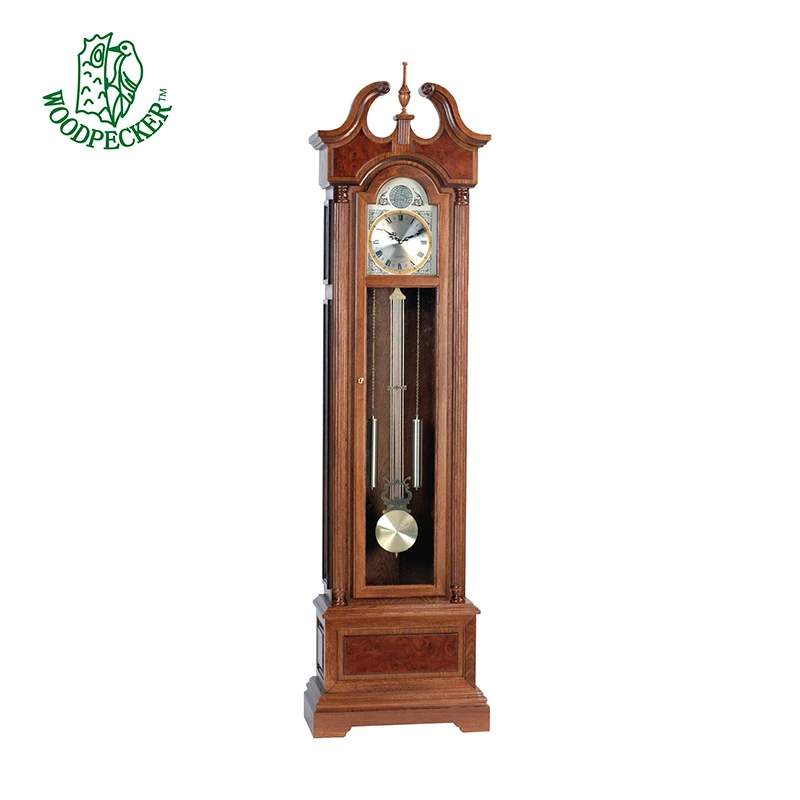
The Traditional Grandfather Clock will bring to your home a classic touch. The traditional style grandfather clock is influenced by an antique design. Grandfather clock’s design focuses on decorative detailed touches, like elaborate carvings and rich detailings. The bonnet or split pediment as well as finials are important features of traditional grandfather clocks. Another distinctive feature of a grandfather clock in traditional style is a moon dial.
Contemporary Style
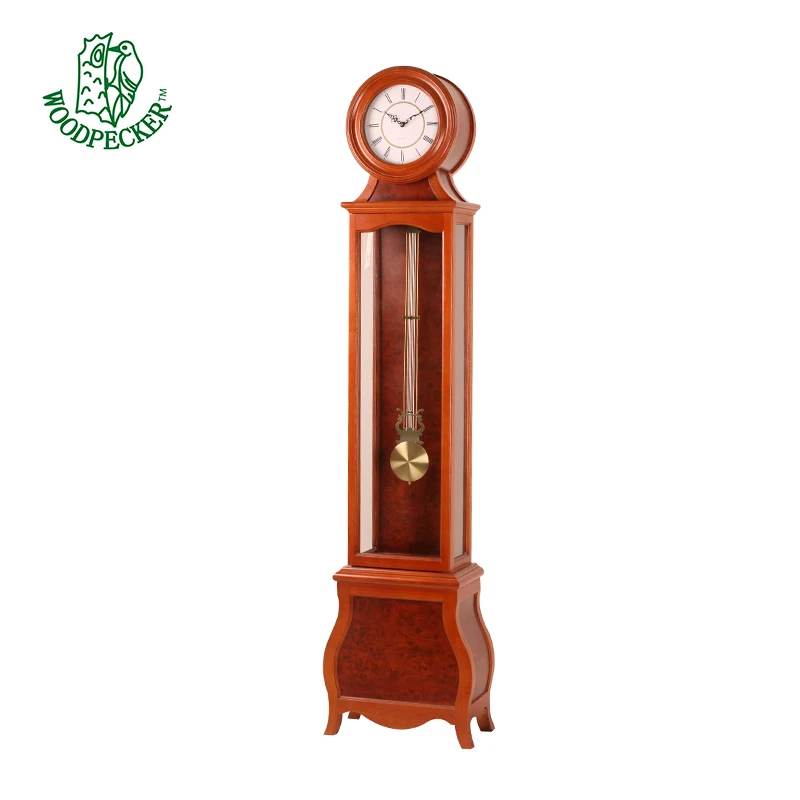
The Contemporary orModern Grandfather Clock is also often called a Floor Clock or a Longcase Clock. The clocks have a smooth look with neutral elements and neat lines. Not only wooden materials but also metal and glass are used in the contemporary style. The simplicity of details is common for floor clocks as well as various types of a clock top.
Transitional Style
The Transitional Grandfather Clock is a combination of traditional and contemporary styles. Transitional grandfather clocks are often made from wood with plain lines and sophisticated details. A grandfather clock in transitional design has a streamline frame compared to the traditional grandfather clocks but at the same time, they are not as sleek as the contemporary ones.
Factors to Consider When Choose Grandfather Clock
The quality, craftsmanship, and aesthetics all play a role when choosing which one will look best in your home or office and our experts are always happy to help you decide which brand is right for you.
The Cost
Grandfather clocks are unique pieces of furniture that can be passed down for generations. They offer a level of sophistication and style that is unmatched by any other type of clock and are a credible investment. Each manufacturer has their own unique design, features and benefits which is reflected in the price so it’s important to do your research before settling on a particular brand.
The Size and Space Considerations
It’s a well known fact that Grandfather clocks, also known as longcase clocks, are beautiful pieces of furniture that can really add some character to a room. But before you go out and buy one, it’s important to make sure you have enough space for it.
Some things to consider when you’re thinking about which clock to choose include:
●Determine how much space is available in the room where it will be placed.
●Decide whether or not there is enough wall space to accommodate its size.
●Think about what style of grandfather clock would look best in your home, such as traditional, contemporary or modern styles.
●Make sure that any movement used inside the case is of high quality.
●Check that the company you are buying from are clock experts and can give you the advice needed to choose, operate and maintain your clock.
●Check into warranty options so that repairs can be made quickly when necessary
●Look at different brands of clocks
●Compare prices
Features and Styles
When you first start looking to buy a grandfather clock, it can be difficult to know where to start. There are so many styles and options available that it can be overwhelming.
Traditional Grandfather Clocks are known for their classic design and simple elegance. They often have intricate designs and carvings that make them stand out in a room. The dials tend to either be painted or brass.
Frequently Asked Questions of Grandfather Clock
We're professional grandfather clock manufacturers and suppliers in China, specialized in providing high quality customized service. If you're going to wholesale grandfather clock made in China, welcome to get quotation from our factory. Good service and low price are available.
italian antique clock, central american antique clock, Arched Grandpa Clock