

Thermometer/hygrometer
Qisangzigo: Your Professional Thermometer/Hygrometer Manufacturer!
Qisangzigo Co., Ltd is a leading manufacturer and supplier of wooden handicrafts. Our company was established in 1989 and is located in Foshan City, China, currently has 100 employees and a factory area of approximately 20,000 square meters. Currently, we mainly sell quartz wall clocks, wood products, thermometers, barometers, wooden boxes, clocks and other products. The products are mainly made from sustainable wood, but we also use other materials such as acrylic and MDF.
Rich Product Range
Our wide range of wood products includes wall clocks, wood products, clocks, handicrafts, alarm clocks, thermometers, barometers, wooden boxes and allows customers to choose from a variety of styles and patterns.
Well Equipped
We have our own wood processing center and modern production lines, equipped with CNC engraving lathes, stamping machines, drilling machines, end lathes and other equipment, with a monthly output of 30,000 watches.
Quality Assurance
We use natural or recycled wood to make these products, and manage our workshops and production lines in accordance with ISO standards to ensure that our products meet international standards such as CE and ROHS.
Customized Services
Our team not only develops new products but also accepts special orders from customers and produces different products according to needs, including OEM, ODM, processing with supplied materials, logo customization and other services.
-
Thermometer with Natural Wood Clock
Brand: Woodpecker, OEM, ODM. Materials: MDF or solid wood. Product size: 27.5×12.5×5cm. Carton size: 53×29.5×27cm
-
Thermometer/hygrometer For Standing
Brand: Woodpecker, OEM, ODM. Materials: MDF or solid wood. Product size: 16×5×28cm. Carton size: 42×32.5×40cm
-
Thermometer with Pen Holder
Brand: Woodpecker, OEM, ODM. Materials: MDF or solid wood. Product size: 18×7.5×19cm. Carton size: 47×41×23cm
-
Wooden Weather Wall
Brand: Woodpecker, OEM, ODM. Materials: MDF or solid wood. Product size: 13×3.5×25cm. Carton size: 72×31×29cm
-
Hanging Type Thermometer
Brand: Woodpecker, OEM, ODM. Materials: MDF + solid wood. Product size: 14.5×4×31cm. Carton size: 53×34×33cm
-
Hygrometer and Barometer
Brand: Woodpecker, OEM, ODM. Materials: MDF + solid wood. Product size: 14.5×4×31cm. Carton size: 53×34×33cm
-
Wooden Thermometer
Brand: Woodpecker, OEM, ODM. Materials: MDF + solid wood. Product size: 38×18.5×5cm. Carton size: 62×41×42cm
-
Vintage Style Thermometer
Brand: Woodpecker, OEM, ODM. Materials: MDF + solid wood. Minimum order quantity: 200pcs. Power source: Battery powered


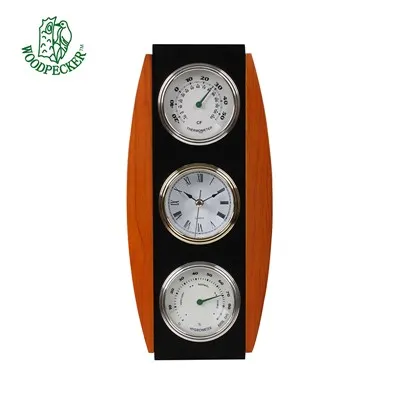
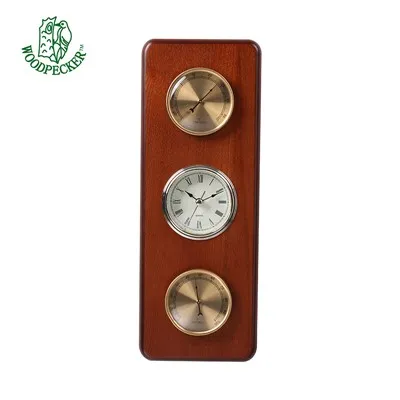


A thermo hygrometer is used to measure air condition. It is capable of quickly and accurately delivering results on the ambient temperature and humidity of air, soil or in confined spaces. Its temperature is typically measured with a digital thermometer. There may be a sensor attached to the device itself or it may have an additional sensor that can be placed in a position that’s remote from the main unit, the humidity is typically measured in one of two ways. They are used widely in the testing of heating, ventilation and HVAC systems. They can also be a valuable tool in determining the quality of the air in an enclosed space that will be used for a wide variety of testing applications, especially when factors such as humidity might affect test results.
Features of Thermo Hygrometer
Minimalist Indicator
Our hygrometer with humidity level icons indicates air conditions and categorizes them into dry, comfortable, wet, etc., ensuring you always know how the air in your home/office is changing with just a quick glance.
High Refresh Rate
With high accuracy of ±2–3%RH and ±1°F, these thermohygrometers are ideal for measuring fluctuating readings in greenhouses. Their data measurements are updated every 10 seconds, giving you the latest parameters of the air in your environment.
Data Records
With their HD MDF transparent display panels, these humidity thermometers display high/low temperature and humidity levels so you can use your home data for correct comparison, ensuring proper indoor humidity.
Practical Design
For ease of use, we've equipped these room thermometers with a desktop stand and a magnetic back so you can place the temperature monitor on your counter or refrigerator.
Thermo Hygrometer are used in numerous areas. They contribute to the maintenance of indoor comfort by enabling the monitoring and adjustment of humidity levels to uphold optimal conditions for human comfort, thereby fostering a healthier and more agreeable indoor environment. They also contribute to the enhancement of air quality by facilitating the regulation of humidity levels, thereby inhibiting the proliferation of mold, bacteria, and dust mites that are known to exacerbate allergies and respiratory issues.
Thermo Hygrometer are frequently utilized in industries such as:
- HVAC
- Refrigeration
- Manufacturing units
- Research labs
- Greenhouses
- Museums
- Clean rooms


Indoor Comfort and Air Quality
Thermo Hygrometer play a significant role in maintaining indoor comfort and air quality. The recommended level of humidity for indoor comfort is between 30-60%. By enabling the regulation of this optimal humidity range, meters can aid in preventing problems like mold growth, dust mites, and respiratory issues, ultimately enhancing the quality of indoor air. Additionally, elevated humidity levels can:
- Counteract the cooling function of air conditioners, resulting in a warmer indoor environment
- Heighten the workload for air conditioning systems
- Diminish efficiency
- Escalate energy usage.
Agriculture and Storage Environments
Humidity control in agriculture helps for achieving optimal yields, improving crop quality, reducing disease, preserving the quality of crops, and minimizing the spread of fungal pathogens. In food storage, elevated humidity levels can result in diminished product quality, spoilage, and the proliferation of mold and bacteria. By monitoring humidity levels and identifying areas where humidity levels are either excessively high or low, a humidity meter can assist in the maintenance of proper storage environments.
Benefits of Thermo Hygrometer
Preventing Health Problems
Maintaining the proper temperature and humidity levels in your home can help prevent the growth of mold and mildew, which can trigger allergies, respiratory problems, and asthma. Additionally, the ideal temperature and humidity levels for human comfort also happen to be the optimal ranges for preventing the growth of viruses and bacteria. Using a thermo hygrometer can help you monitor these levels and ensure that your indoor air quality stays within the ideal range for your health and comfort.
Identifying Sources of Indoor Air Quality Problems
A thermo hygrometer can help you identify sources of indoor air quality problems in your home. For instance, if you notice a sudden increase in humidity levels, it could be an indication of a leak or other water damage. Similarly, if the temperature in one area of your home is significantly different from the rest of the house, it could be a sign of a draft or other insulation problems. By identifying these issues early on, you can take steps to address them and prevent more serious indoor air quality problems down the line.
Optimizing Energy Usage
By monitoring your indoor temperature and humidity levels, you can optimize your energy usage and save money on your energy bills. For example, during the summer months, keeping your home within the ideal temperature range of 72-78°F can reduce the amount of energy used for air conditioning. In the winter months, keeping your home within the ideal temperature range of 68-72°F can reduce the amount of energy used for heating. Additionally, maintaining proper humidity levels can also help reduce the amount of energy used for heating and cooling by improving the efficiency of your HVAC system.
Sensors Types of Thermo Hygrometer
Thermometer
●Negative Temperature Coefficient (NTC) Thermistor
A thermistor is a thermally sensitive resistor that exhibits a continuous, small, incremental change in resistance correlated to variations in temperature. An NTC thermistor provides higher resistance at low temperatures. As temperature increases, the resistance drops incrementally, according to its R-T table. Small changes reflect accurately due to large changes in resistance per °C. The output of an NTC thermistor is non-linear due to its exponential nature; however, it can be linearized based on its application. The effective operating range is -50 to 250 °C for glass encapsulated thermistors or 150°C for standard thermistors.
●Resistance Temperature Detector (RTD)
A resistance temperature detector, or RTD, changes the resistance of the RTD element with temperature. An RTD consists of a film or, for greater accuracy, a wire wrapped around a ceramic or glass core. Platinum makes up the most accurate RTDs while nickel and copper make RTDs that are lower cost; however, nickel and copper are not as stable or repeatable as platinum. Platinum RTDs offer a highly accurate linear output across -200 to 600 °C but are much more expensive than copper or nickel.
●Thermocouples
A thermocouple consists of two wires of different metals electrically bonded at two points. The varying voltage created between these two dissimilar metals reflects proportional changes in temperature. Thermocouples are nonlinear and require a conversion with a table when used for temperature control and compensation, typically accomplished using a lookup table. Accuracy is low, from 0.5 °C to 5 °C but thermocouples operate across the widest temperature range, from -200 °C to 1750 °C.
●Semiconductor-based Temperature Sensors
A semiconductor-based temperature sensor is usually incorporated into integrated circuits (ICs). These sensors utilize two identical diodes with temperature-sensitive voltage vs current characteristics that are used to monitor changes in temperature. They offer a linear response but have the lowest accuracy of the basic sensor types. These temperature sensors also have the slowest responsiveness across the narrowest temperature range (-70 °C to 150 °C).
Hygrometers
●Electrical Hygrometers
These hygrometers use resistance or capacitance to measure the amount of humidity in the air. Electrical hygrometers can either be capacitive or resistive. Capacitive hygrometers have two metals plates that have air between them; the moister the air is, the more it affects the plates’ ability to store a static electric charge. The amount of humidity is indicated by the metal plates’ ability to store the electric charge. Resistive hygrometers, electricity passes through a piece of ceramic substance which is exposed to the air. The higher the humidity, the more water vapour condenses inside the ceramic, leading to a change in resistance.
●Psychrometers
This type of hygrometer comprises two thermometers: one that has a dry bulb, and one that has a wet bulb. When evaporation occurs in the wet bulb, the temperature drops to a lower level than that of the dry bulb. This difference in temperature is caused by the humidity in the air.Psychrometers are ideal for measuring outdoor humidity and areas which need dry storage conditions.
●Dew Point Hygrometers
Dew point hygrometers are used to measure the saturation of moist air in a gas. These hygrometers are used in areas where the smallest amounts of moisture need to be found. These devices are the most precise of all the hygrometers.
How to Calibrate a Thermo Hygrometer?
The standard way for a Thermo hygrometer and/or hygrometer calibration is to use a special chamber or a humidity generator, this is usually performed in a lab. The humidity generator can be varied to different ranges of humidity and temperature.
This method can be applied for the hygrometer calibration procedure. It is only the humidity that is calibrated. It is purely a comparison between a standard or more accurate Thermo-hygrometer and a regular thermo-hygrometer which we call a unit under calibration (UUC) where adjustment is not required unless the instruments have the capability to be adjusted.
Calibration Procedure:
(1)Check the thermo-hygrometer for any visual defects that can affect its accuracy. Discontinue calibration if any defect is noted.
(2)Clean the thermo-hygrometer with a soft cloth, carefully check the sensor for any signs of dust or contamination. Check if it has good batteries, replace low powered batteries.
(3)Prepare the measurement data sheet (MDS) and record all necessary details or information ( Brand, Model, serial #, etc).
(4)Calibration will be based on the room or ambient condition, so make sure that the room has a stable temperature. A confined space where air movements are very minimal is better.
(5)Place the thermo hygrometer and the Unit Under Calibration(UUC) together, the sensors of both instruments must be close together and at the same level, use a holder if necessary. Allow the units to stabilize for at least 30 minutes. Temperature and humidity will be obtained in the same way.
(6)Once stabilized, get the readings on their display.
(7)Perform 3 times and record readings on the MDS.
(8)Check readings if within the accuracy defined by the manufacturer, for the example above, accuracy = +/-3% for humidity and +/-1 DegC for temperature.
(9)If the readings are already within limits update the corresponding record, do labeling and sealing, and issue to the owner, otherwise, do necessary repairs or adjustment.
Frequently Asked Questions of Thermo Hygrometer
We're professional thermometer/hygrometer manufacturers and suppliers in China, specialized in providing high quality customized service. If you're going to wholesale thermometer/hygrometer made in China, welcome to get quotation from our factory. Good service and low price are available.
Wooden Weather Wall, Thermometer with Pen Holder, Hygrometer and Barometer