

Pendulum Clock
Qisangzigo: Your Professional Pendulum Clock Manufacturer!
Qisangzigo Co., Ltd is a leading manufacturer and supplier of wooden handicrafts. Our company was established in 1989 and is located in Foshan City, China, currently has 100 employees and a factory area of approximately 20,000 square meters. Currently, we mainly sell quartz wall clocks, wood products, thermometers, barometers, wooden boxes, clocks and other products. The products are mainly made from sustainable wood, but we also use other materials such as acrylic and MDF.
Rich Product Range
Our wide range of wood products includes wall clocks, wood products, clocks, handicrafts, alarm clocks, thermometers, barometers, wooden boxes and allows customers to choose from a variety of styles and patterns.
Well Equipped
We have our own wood processing center and modern production lines, equipped with CNC engraving lathes, stamping machines, drilling machines, end lathes and other equipment, with a monthly output of 30,000 watches.
Quality Assurance
We use natural or recycled wood to make these products, and manage our workshops and production lines in accordance with ISO standards to ensure that our products meet international standards such as CE and ROHS.
Customized Services
Our team not only develops new products but also accepts special orders from customers and produces different products according to needs, including OEM, ODM, processing with supplied materials, logo customization and other services.
-
Classic Antique Pendulum Clock
A pendulum clock is a clock that uses a pendulum, a swinging weight, as its timekeeping element. The advantage of a pendulum for timekeeping is that it is an approximate harmonic oscillator: it
-
Arched Wall Clock
Brand: Woodpecker, OEM, ODM. Materials: MDF+solid wood. Product size: 24×60×10cm. Carton size: 65.5×54×29cm
-
Saybrook Wall Clock
Brand: Woodpecker, OEM, ODM. Materials: MDF+solid wood. Product size: 29.3×59.5×10cm. Carton size: 66×58×35cm
-
Sophisticated Pendulum Clock
Brand: Woodpecker, OEM, ODM. Materials: MDF+solid wood. Minimum order quantity: 200pcs. Power source: Battery powered
-
Stately Wooden Wall Clock
Brand: Woodpecker, OEM, ODM. Materials: MDF+solid wood. Product size: 29×16×83.5cm. Carton size: 91×42×36cm
-
Vintage Wood Indoor Wall Clock
Brand: Woodpecker, OEM, ODM. Materials: MDF+solid wood. Product size: 27×8×61.5cm. Carton size: 68×50×34cm
-
Traditional Schoolhouse Pendulum Clock
Brand: Woodpecker, OEM, ODM. Materials: MDF+solid wood. Product size: 32×55.5×7cm. Carton size: 61×54.5×37cm
-
Arched Wooden Pendulum Clock
Brand: Woodpecker, OEM, ODM. Materials: MDF+solid wood. Product size: 32×55.5×7cm. Carton size: 61×54.5×37cm
-
Continental Wall Clock
Brand: Woodpecker, OEM, ODM. Materials: MDF+solid wood. Product size: 26.5×11×57cm. Carton size: 63×62×32.5cm
-
Storage Wall Clock
Brand: Woodpecker, OEM, ODM. Materials: MDF+solid wood. Product size: 26×62.5×13cm. Carton size: 69×36×32cm
-
Modern Wall Clock
Brand: Woodpecker, OEM, ODM. Materials: MDF. Minimum order quantity: 200pcs. Power source: Battery powered
-
Wall Clock with Pendulum
Brand: Woodpecker, OEM, ODM. Materials: MDF+glass. Minimum order quantity: 200pcs. Power source: Battery powered


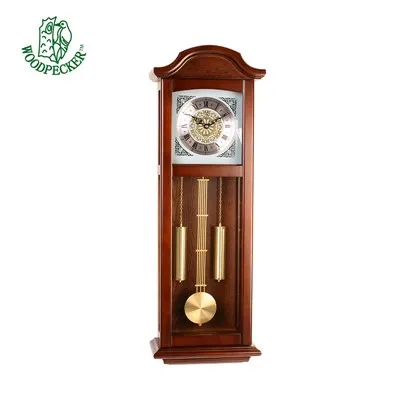


High quality solid wood, for you to show different beauty.The vault part of arched wall clock is to be made of solid wood spliced into a complete circle and then split in two.
A pendulum clock is a clock that uses a pendulum, a swinging weight, as its timekeeping element. The advantage of a pendulum for timekeeping is that it is an approximate harmonic oscillator: It swings back and forth in a precise time interval dependent on its length, and resists swinging at other rates. Throughout the 18th and 19th centuries, pendulum clocks in homes, factories, offices, and railroad stations served as primary time standards for scheduling daily life, work shifts, and public transportation. Their greater accuracy allowed for the faster pace of life which was necessary for the Industrial Revolution. The home pendulum clock was replaced by less-expensive synchronous electric clocks in the 1930s and '40s.
Features of Pendulum Clock
Various Styles
The standard size of our pendulum clock is 9 inches wide, 3 inches deep, and 16 inches high. We also provide larger or mini sizes, and support the replacement of colors and materials.
Quiet Working
Our pendulum clock has a built-in wood-look pendulum with sweep and silent motion modes that will make no ticking sound when moving back and forth, adding more tranquility to your life.
Easy to Read
These pendulum clocks feature a regulator design with a white analog dial with easy-to-see three-dimensional black Roman numerals and long hands so you can see the time from across the room.
Concise Timing
These durable wall clocks are battery powered and keep your walls clean and tidy without any wires and complicated setup. They also come with simple mounting accessories and can be hung on the wall or placed directly on the table.
Common Application of Pendulum
Every pendulum is some kind of mass hung from a fixed point that swings freely by the force of gravity and remains in motion until another force stops it. Pendulums play important roles in mechanical clocks, park swings and building foundations.
Keeping Time
The most commonly recognized use of pendulums is observed in clocks. Many clocks, most notably the "grandfather clock," use a pendulum to tally time. The pendulum swings back and forth at exact intervals determined by the length at which the pendulum is suspended. To measure time accurately, a pendulum clock must remain stationary. Any sudden maneuver of the clock interferes with the regular motion of the pendulum. Until the 1930s, it was the world's most precise timekeeper. In the 21st century, pendulum clocks are most valued for their craftsmanship and beauty.
Keeping the Beat
A pendulum is used in a metronome, which helps maintain the speed of music. The metronome dates to the 19th century. It is a hollow box with a pendulum attached to a moving weight with a fixed weight at the bottom. A number scale allows the musician to adjust the tempo desired for the piece being played. The scale indicates the number of fluctuations per minute so the required beat can be matched with the tempo of the music.


Recreation and Amusement
Attend the circus and you see the trapeze artist swinging like a pendulum in the air. Take the pirate ride at the amusement park and become one with the pendulum as your gondola seat swerves in a deep arc from one side to the other. Ride a pendulum when you hop on the swing in your local park. Create a pendulum in the backyard by tying an old tire to the branch of a sturdy tree.
Protection from Earthquakes
The design of the San Francisco International Airport terminal employs mechanical devices called Friction Pendulums to protect the building from earthquake damage. These supports create a pendulum motion that allows the building to sway with the shifting of the ground, thereby reducing the chances of catastrophic structural damage. Industrial buildings and bridges incorporate the same concept.
Pros and Cons of Pendulum Clock
Pros Of Pendulum Clocks
●Decorative Values: Pendulum clocks are the earliest versions of contemporary timepieces featuring complicated mechanics. They are like living works of art that you may enjoy in your house.
●Requiring Minimal Intervention: The internal workings of your pendulum clocks can be messed with, adjusted, and synced as needed.
●Needs No External Power Source: You don't need an external power source to run a pendulum watch.
Cons of Pendulum Clocks
●Temperature-Related Clock Setting Disruption: The length of the pendulum is set to one second, and as the temperature rises, the pendulum expands, forcing the clock to play slower and lag. The inverse is correct in colder regions.
●Unsuitable In Places That Are Constantly Moving: They are not suitable for usage in unsteady environments such as ships and trains.
●They Need Periodic Mechanic Repairs: A watchmaker must examine a wall clock pendulum and perform any necessary maintenance.
Types of Pendulum in Clock
There are three basic categories for types of clock pendulums. These are lyres, wood sticks and brass rods.
Metal Lyre
A Metal Lyre pendulum is a type of clock pendulum that is most decorative of pendulums. A floor clock can mean a grandfather, grandmother, or granddaughter clock. Basically, any clock that sits on the floor versus a wall or mantle. These types of clock pendulums are for post WW2 German movements.
Generally speaking, the stamp may have another name on the backplate of the movement. This is due to companies paying a premium to have their name put on the movement. However, this does not change who the actual manufacturer is.
Wood Stick
The wood stick type of clock pendulum is sent with no stain on it. This is so the stick can have the same stain to match the clock case. Likewise, a black stick looks nice with the gold bob as well. Certainly, by leaving it plain the customer can customize the stick to whatever color they deem fit.
A wood stick type of clock pendulum consists of the stick, the top hook, the rating assembly and the round bob. They are capable of accepting any size bob and can easily be cut if too long. Because of these qualities, they are the most versatile pendulums out of the three.
Brass Rod
Shelf clocks or wall clocks mainly use brass rod types of clock pendulums. It is not common for them to be on granddaughter or grandmother clocks. It is possible but not likely. These pendulums tend to cost more for a couple of reasons.
First, they are made of brass. Of course this is a much more expensive medium than the wood. We will cut it to the exact length needed for the specific clock movement upon ordering.
Reasons Causing a Pendulum Clock to Stop Working and Their Solutions
If you know why the antique pendulum wall clock stopped working, you can fix the problem on your own. Here are some reasons why this is the case.
Strike in a Pendulum Case
The pendulum may only swing freely without hitting any stationary objects. The pendulum may become trapped on an item during the clock, especially owing to the carrying of the clock. You may operate it by moving the pendulum from the front or the back of the clock.
Hands Squeezed
As the pendulum swings, you should be able to hear its ticking sound. A simple hand motion will do this task. It is highly likely that the hands of the clock get stuck if there is no sound. Hands often contact the watch face. When this happens, you'll have to give them a little bend. It is preferable to begin with the minute hand.
Mixed Chains
Ensure that the pendulum's chains and other hanging pieces are properly hung. Ropes and chains must not be bundled. It may be necessary to replace the chain sprocket if it gets separated.
Debris and Dried Oil
The pendulum clock mechanism can become inoperable if the oil leftovers from earlier repairs dry out. Clean the area with alcohol or degreaser, then re-lubricate.
How to Adjust a Pendulum Clock Chime?
It is essential to be familiar with certain adjusting pendulum clock if you have one. Otherwise, you might have to carry these bulky tools to the watchmaker's shop each time. Here are the very important adjustments you need to know about the grandfather clock pendulum. 3 different adjustments are usually needed for the chiming wall clocks with pendulum.
Conflicting Ringtone with The Current Time
The solution is straightforward if you have a mechanical clock and you get a synchronization fault. Set the watch to 3 o'clock by dragging the hour and minute hands to that position. Then, by moving the minute hand, you will see that it rings one gong at 6 and three gongs at 12. If your watch beeps three times at 6 o'clock, remove the minute hand, reinsert it in the opposite direction, and repeat the process.
Early or Late Chimes
The gong sound can come in early or late on occasion as a result of desynchronization; in such a situation, the watch would require another synchronization. Just follow these steps to synchronize your watch:
(1)Adjusting pendulum clock
(2)Take off the hand nut that's in the middle.
(3)Remove the minute hand and grasp the nut located behind it firmly.
(4)Pendulum clock adjustment steps
(5)The next step is to press the minute hand while holding the nut steady with your other hand for about three to four minutes.
(6)Next, place the minute hand firmly and spin it to ensure it works. Remove the minute hand and repeat the rotation process depending on early or late ringing.
Tuning the Chime
The distance between the hammers and the bars influences how loud the sound is. To adjust a hammer, take a tiny pair of flat pliers and hold the end of the handle away from the head. Apply a little pressure by bending the handle up or down with your other hand or another pair of pliers. It is recommended that hammerheads leave a 1/8-inch gap from the bell bars.
FAQ
We're professional pendulum clock manufacturers and suppliers in China, specialized in providing high quality customized service. If you're going to wholesale pendulum clock made in China, welcome to get quotation from our factory. Good service and low price are available.
pendulum clock striker, pendulum clock packaging, wall mounted pendulum clock